
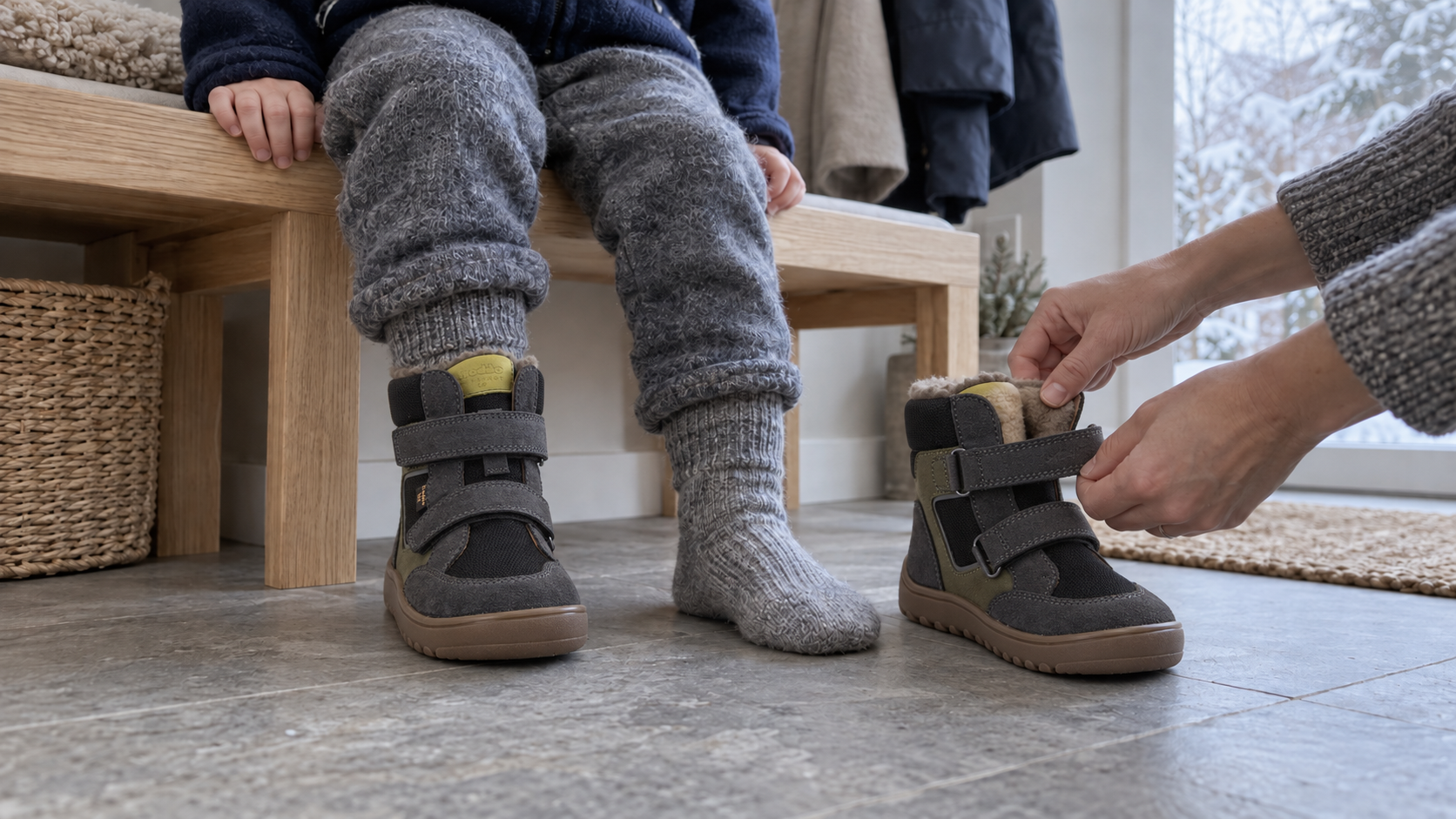
The warmest-looking winter boot is not always the warmest in practice. Socks, fit, usable space and activity all affect thermal comfort. These seven checks will help you choose winter barefoot shoes that work with the foot rather than crowding it.
A good winter barefoot shoe should leave the toes free to move, stay secure around the heel and ankle, and provide insulation suited to the weather and the way the shoe will be worn. That applies to children and adults alike.
1. Measure Feet in the Socks You Will Actually Wear
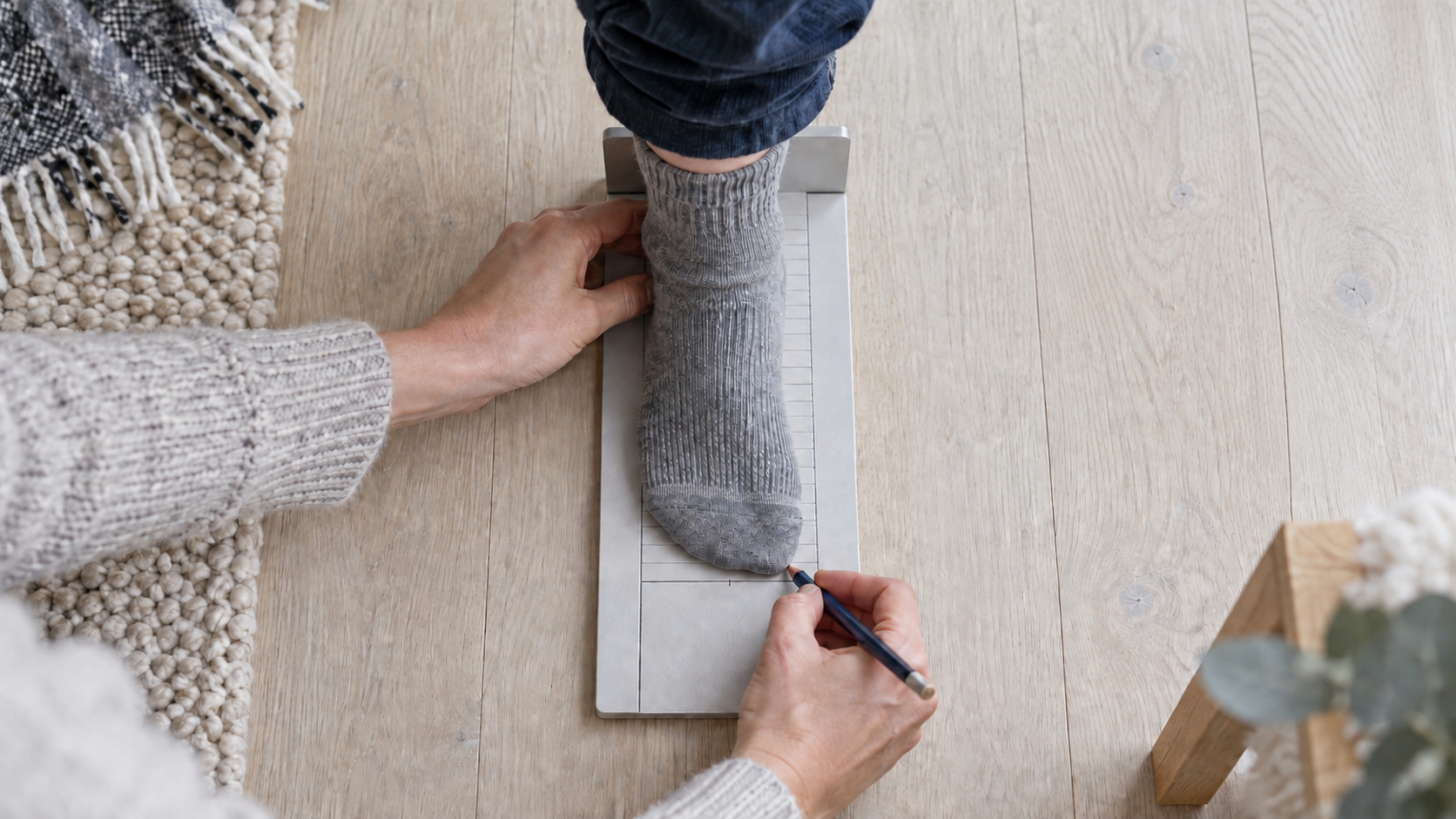
There is no need to guess how many millimetres a thicker sock might add. Measure both feet while wearing the socks intended for the winter shoes, then use the larger measurement.
This matters most with thick winter or functional socks, which can change not only the required length but also the volume around the forefoot and instep. If you alternate between different socks, fit the shoe with the thickest pair you expect to wear regularly.
Simple rule: measure the real combination—foot plus sock—instead of measuring barefoot and estimating afterwards.
2. Leave Enough Extra Room
A winter shoe needs space for the foot to lengthen and spread during a step, as well as room for the toes to move. For growing children, the allowance also needs to cover growth. The right amount is individual, but these figures are useful starting points:
- Minimum for children and adults: approximately 0.5 cm.
- Prewalkers and first walkers: approximately 0.5–0.8 cm.
- Experienced child walkers: often approximately 1–1.2 cm.
- Adults: approximately 0.5–1.2 cm, depending on personal preference and control of the shoe.
These are guidelines, not a formula. Some adults are most comfortable with 0.5–0.7 cm, while some experienced children notice immediately when their allowance falls below 1 cm. The final decision should combine measurements with how the shoe behaves during walking.
More is not always better. Too much extra length can make a first walker trip or force any wearer to grip with the toes to control the shoe.
3. Check the Whole Fit, Not Just the Length
Two shoes with the same internal length can feel completely different. Width, toe-box shape, instep height and heel volume all matter.
With the intended socks on, check that:
- the toe box follows the shape of the toes and does not push the big toe inward,
- the toes can move and are not pressed from above,
- the foot is not squeezed at its widest point,
- the upper does not press across the instep,
- the heel and ankle feel secure without painful pressure,
- the foot does not slide excessively when walking.
A shoe can be long enough and still be too narrow or too low-volume. It can also have a wide toe box but be too loose at the heel. Fit is the relationship between the entire foot and the entire shoe.
Why this matters in winter: even a boot with thick wool can feel cold if the foot and toes are compressed. Insulation needs space to work, and the foot needs space to move.
4. Expect Wool and Fur to Settle—But Never Buy a Tight Shoe
Wool and lambskin fur naturally compress a little with wear. After several outings, the lining may feel less full and the interior may seem slightly roomier.
That does not mean a new winter shoe should squeeze the foot. There is an important difference between feeling the soft lining around the foot and feeling pressure.
Close contact with soft wool or fur can be normal. Pressure on the toes, rubbing, numbness, visible compression or a foot that cannot spread is not. Do not buy a tight boot on the assumption that it will eventually “wear in” enough to fit.
5. Match the Insulation to the Climate and Activity
The thickest insulation is not automatically the best choice. A child running outdoors in a mild city winter has different needs from someone standing still at a cold playground or spending hours outside in freezing conditions.
Light textile or microfibre lining
A practical choice for milder winters, transitional weather and active wearers. It gives more flexibility when conditions change.
100% sheep wool
A warmer option for genuinely cold days. Wool helps regulate temperature and manage moisture inside the shoe, but it may be more insulation than necessary in a mild climate.
Lambskin fur
Soft, plush and comfortable around the foot. It can be especially appealing to wearers who are sensitive to the feel of a classic wool lining.
Also consider movement. Walking and playing generate warmth; standing still for a long time does not. No lining can compensate perfectly for extended inactivity in very cold weather.
For a closer look at how these choices work within one collection, see our guide to Froddo Barefoot versus Barefoot UP fits and winter insulation.
6. Build Warmth in Adaptable Layers
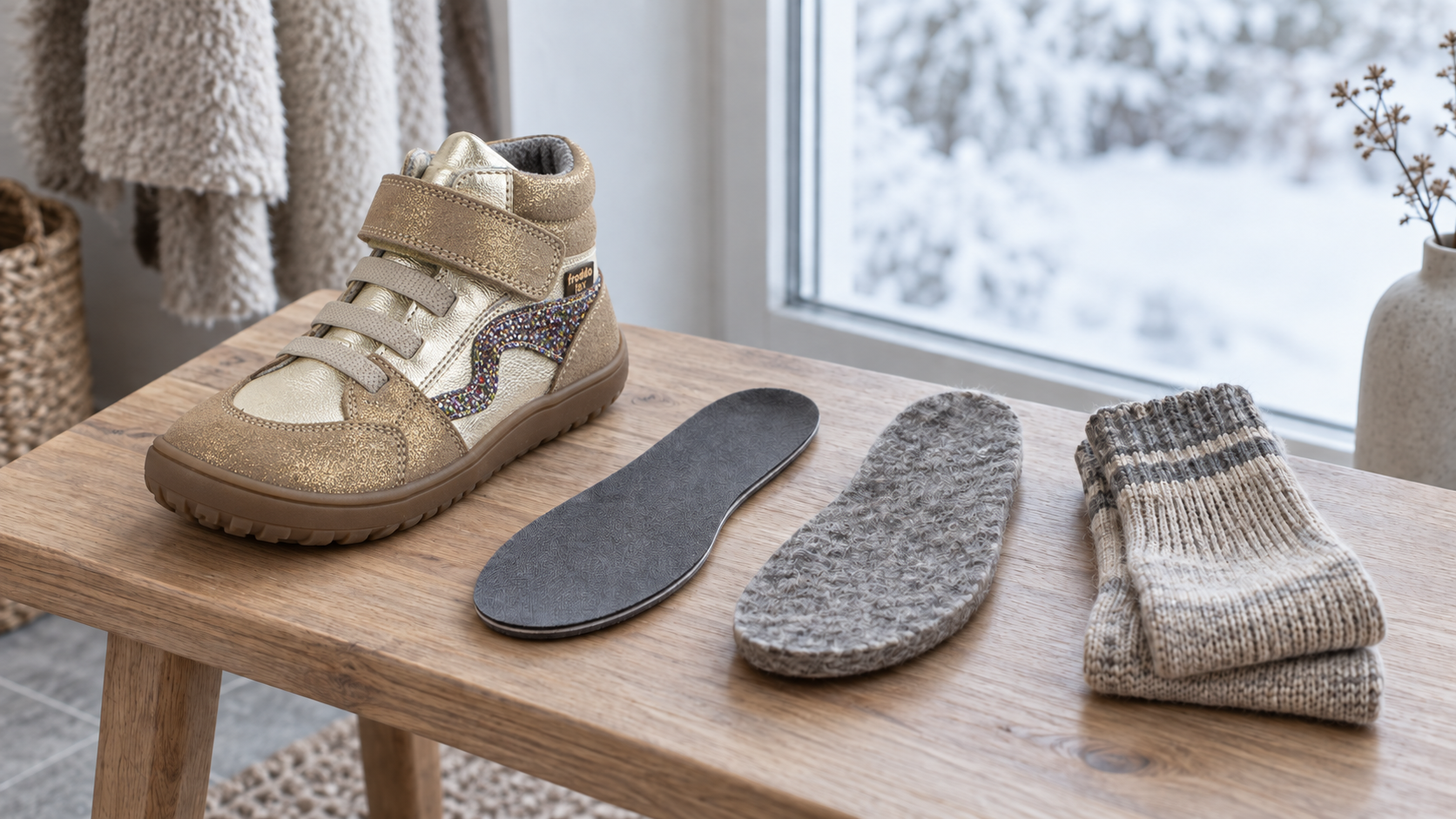
A lightly insulated shoe does not have to be set aside as soon as the temperature drops. If the model has a removable insole, you can replace it with an OmaKing insulated insole and pair it with a suitable functional sock.
Replace the original insole rather than automatically stacking two insoles. Then check the fit again: added insulation takes up volume, and the toes and instep must not become compressed.
Socks should support comfort without making the shoe tight. A very thick sock in a close-fitting boot can be less comfortable—and may feel colder—than a thinner functional sock in a shoe with enough room.
Think in systems: shoe, sock and insole work together. Change one layer and the fit of the whole system changes.
7. Choose Weather Protection for Real Conditions
A membrane is useful when winter is wet and changeable. It adds protection against moisture while the shoe remains suitable for everyday walking and play.
Leather without a membrane is not automatically a dry-weather-only option. Quality leather, cared for regularly and treated with a product suitable for that exact material, can handle normal winter dampness well.
Neither a membrane shoe nor treated leather is a rubber boot. Long exposure to puddles, deep wet snow or complete saturation can eventually allow moisture inside. If conditions are exceptionally wet, choose footwear made for that specific use and allow damp shoes to dry naturally before wearing them again.
Warmth Depends on Fit as Much as the Label
Cold-weather comfort is the result of several small decisions working together:
- the foot is measured in the intended socks,
- the shoe has enough length and volume,
- the toe box matches the shape of the foot,
- the heel is secure without being squeezed,
- the insulation suits the climate and activity,
- the sock and insole do not overcrowd the interior,
- the weather protection matches the conditions.
When these elements are balanced, the foot can move naturally and the insulation can do its job. That is more useful than simply choosing the thickest-looking boot.
Shop Winter Barefoot Shoes
Kids’ Barefoot Winter Shoes & Boots
Winter footwear for growing feet, from first walkers to older children.
Women’s Barefoot Winter Shoes & Boots
Flexible winter styles for everyday wear and colder conditions.
Men’s Barefoot Winter Shoes & Boots
Roomy, foot-shaped winter footwear for men.
Final fit check: walk in both shoes with the intended socks. The toes should remain free, the foot should not be compressed and the heel should stay controlled. Warmth starts with a shoe that truly fits.